Publications
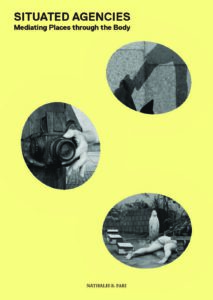
PhD Diss. (2024), Art Monitor Series, University of Gothenburg.
At a time when our ways of experiencing and enliven spaces and places in the city have become increasingly entangled with – or even dictated by – technology, the artistic research project Situated Agencies: Mediating places through the Body, examines how site-specific performance practice can be addressed through an embodied and documentary approach. Drawing from place-based research, performance documentation and posthumanism, a series of performance laboratories were carried out in collaboration with artists/researchers from different disciplinary fields at specific places in Gothenburg and Rio de Janeiro. At the core of these laboratories was the exploration of the relationship between embodiment and audiovisuality; especially by experimenting with how the audiovisual traces of a laboratory work can serve both as data and creative source for developing different forms of narrativisation.
This PhD thesis also includes the following articles:
Collaborative article: Ribeiro, Walmeri, Fari, S. Nathalie, Cezar Campos, Ruy and Baio, Cesar. (2021) “From Embodiment to Emplacement: Artistic Research in Insular Territories of the Guanabara Bay.” Global Performance Studies, vol. 4, no. 2. DOI: https://doi.org/10.33303/gpsv4n2a8
Article: (2023) Performing whiledocumenting or how to enhance the narrative agency of a camera. Theatre, Dance and Performance Training, 14(1), 46–56. DOI: https://doi.org/10.1080/19443927.2022.2162572
Book Chapter: (2023) “Corpo e Imagem: Como capturar um momento performativo” (EN: Body and Image: How to capture a performative moment). In: Territórios Sensíveis: Práticas Artísticas no Antropoceno (EN: Sensitive Territories: Artistic Practices in the Anthropocene), edited by Walmeri Ribeiro. Editora Circuito: Rio de Janeiro
TERRITÓRIOS SENSÍVEIS (Sensitive Territories), initiated in 2014 by Walmeri Ribeiro, is a collaboration platform for artist-researchers, scientists and local communities. Situated at the intersection of art, technology and environmental issues, especially the impact of climate change on ways of living, the project explores the potential of art to promote socio-ambiental awareness. It explores how micro-political gestures can destabilise our individual and collective thoughts and practices in relation to what we commonly refer to as nature.
This book gathers contributions from artist-researchers who took part in the 2019–20 editions of the project, which focused on an engagement with specific territories and communities located at the Guanabara Bay in Rio de Janeiro.
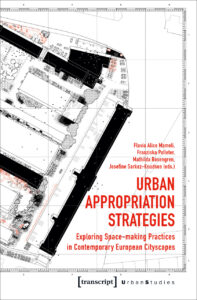
Book Chapter (2018), Mapping the Teufelsberg or How to Embody History. In Urban Appropriation Strategies: Exploring Space-making Practices in Contemporary European Cityscapes, edited by Flavia Alice Mameli, Franziska Polleter, Mathilda Rosengren, and Josefine Sarkez-Knudsen, pp. 52-60. Bielefeld: Transcript.
In the past years, the transiency of European city-making and dwelling has become increasingly hard to disregard. This urban flux calls for a methodological rethinking for those professionals, social and natural scientists, artists, and activists, with an interest in the processes of remaking and reclaiming urban space. With a practical and empirical emphasis, this anthology brings forth a variety of perspectives on urban appropriation strategies, their relation to public space-making, and their implications for future city development, exploring how ideas and practices of appropriation inform and relate to cultural narratives, politico-historical occasions as well as socio-ecological expressions.
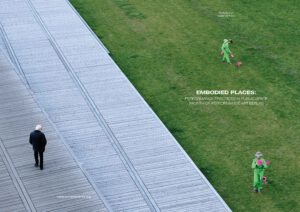
Anthology (2015), Embodied Places: Performance Practices in Public Space. Berlin: atelier obra viva.
This anthology showcases the works that atelier obra viva has produced in collaboration with artists and scholars from different fields for past editions of the Month of Performance Art–Berlin. It explores various artistic strategies, concepts and formats for staging performances in public spaces, using particular sites in Berlin as platforms to “embody” the city. To make these embodied places more tangible, artists were invited to write a report on what happened (or might have happened) in the space. These reports not only cover the performance experience, such as particular situations, moments or gestures, but also construct a narrative by experimenting with different ways to describe a performative event. For example, they use either the present or past tense. The artists are thus acting as authors, creating their own narratives based on their memories, knowledge, and experiences of the event.
Featured artists/authors: Bettina Wagner, Dovrat Meron, Grasiele Sousa, Lucio Agra, Michaela Muchina, Nathalie S. Fari and Paula Marie Hildebrandt.
MA Diss. (2008): MEIN_RAUM: Von der Suche nach Verortung (EN: MY_SPACE: On the search for locational identity). Weissensee Kunsthochschule Berlin
In the age of globalisation, the question of place — where we are, where we come from, and where we feel at home — has become urgent. It has become increasingly challenging to grasp one’s own origins and the concept of home, as almost everyone is directly or indirectly impacted by the changes brought about by migration. In theory, anyone could feel at home anywhere in the world, but there are certain reasons why developing this special connection to a place can be extremely difficult.
In this thesis, the search for one’s ‘own space’ departs from Vilém Flusser’s writings (1920–1991) on home and migration, particularly his concept of ‘Bodenlos’. Here, this concept serves as a framework for analysing three forms of ‘Bodenlosigkeit’: geographic, social, and creative.
OTHER CONTRIBUTIONS:
Video-articles:
- (2020) “Notes from a zoom 5Rhythms® session”. In: Embodiment and Social Distancing, edited by Elisabeth de Roza, Nathalie S. Fari, Cara Hagan and Ben Spatz. Journal of Embodied Research, 3(2), 1. DOI: http://doi.org/10.16995/jer.64 (Part of PhD thesis)
- (2021) “Paquetás resting body or (re)tracing its documentary meaning”. Part of the article From Embodiment to Emplacement: Artistic Research in Insular Territories of the Guanabara Bay. Global Performance Studies, vol. 4, no. 2. DOI: https://doi.org/10.33303/gpsv4n2a8 (Part of PhD thesis)
Edited volumes:
- (2024) “u m z i e h e n”. In: Mica Moca: a passionate relationship to reality, edited by Frederic Wake-Walke, Christophe Knoch and Christian Anslinger, pp. 50-51. Berlin: George Bailey.
- (2016) “MEIN_RAUM”. In: Evocações da Arte Performática (2010-2013), edited by Paulo Aureliano da Mata, pp. 349-50. Jundiaí: Paco Editorial.
- (2015) “MEIN_RAUM”. In: Mostra de Performance Arte, edited by Marcos Gallon, p. 226. São Paulo: Tijuana.
- (2011) “Wasser als Lebenselixier“. In: Alles Fließt, edited by Marianne Stüve, pp. 150-51. Nürnberg: Ponte Cultura e.V.